China Defends Firms: Stunning Stand Against US Tariffs


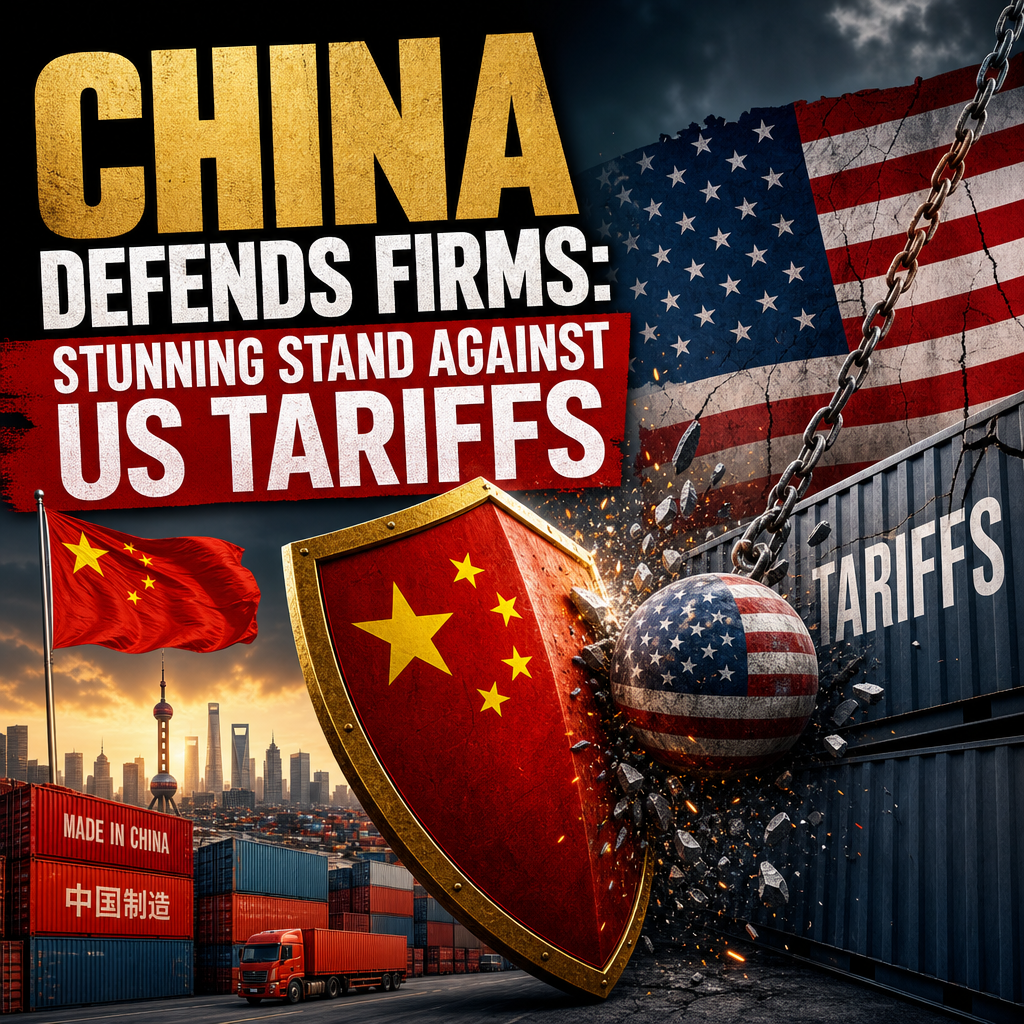
China Defends Firms as tensions with Washington deepen, and the latest dispute over tariffs and sanctions highlights how quickly trade policy is turning into a broader contest over technology, security, and influence.
At the center of the latest flare-up is China’s argument that its companies are being unfairly targeted by the United States through tariffs, export restrictions, and other sanctions-style measures. Beijing’s message is not just that these steps hurt individual firms, but that they distort competition and punish ordinary commerce under the banner of national security. U.S. officials, meanwhile, frame the restrictions as necessary safeguards against market distortion, overcapacity, and strategic dependencies that they say could weaken American industry and security.



The clash is not happening in a vacuum. It reflects a broader pattern seen across recent reporting from international outlets: China is trying to position itself as a defender of legitimate business activity, while the U.S. increasingly argues that economic openness cannot be separated from geopolitical risk. That divide is now shaping everything from semiconductors to electric vehicles, and both sides appear convinced they are responding to the other’s escalation.
Why China is pushing back
Beijing’s defense of its firms fits a familiar diplomatic strategy. Rather than portraying the situation as a simple trade quarrel, Chinese officials tend to describe U.S. measures as discriminatory, politicized, and harmful to the global economy. The logic is straightforward: if tariffs and sanctions are used too broadly, they stop being targeted tools and become a way to pressure rivals into accepting American rules.




Chinese state-linked commentary and official statements often emphasize several points:
– U.S. restrictions can raise costs for consumers and businesses in both countries.
– Sanctions can create uncertainty for global supply chains, not just Chinese exporters.
– Broad trade penalties may accelerate decoupling rather than solve the underlying dispute.
– Domestic Chinese firms, especially in high-tech sectors, can be pushed to innovate faster under pressure.
There is also a political dimension. Defending firms allows Beijing to present itself as protecting national economic interests, especially at a time when external pressure can be used to reinforce internal support. That framing matters because it turns a trade dispute into a question of sovereignty and resilience.
Still, the Chinese position is not without weaknesses. Critics point out that some of the friction is connected to issues Washington has raised for years, including market access, state support for key industries, and concerns over industrial subsidies. From that perspective, China’s complaint about unfair treatment can sound selective if it does not fully address the structural concerns behind U.S. policy.
The U.S. case: security, competition, and leverage
Washington’s argument is more complicated than simply wanting to “win” a trade fight. U.S. policymakers have increasingly treated economic policy as an extension of strategic competition. That means tariffs and sanctions are presented as tools to slow what officials see as unfair industrial scaling, protect sensitive technologies, and reduce dependence on Chinese supply chains.
The U.S. case typically rests on three claims:
1. National security — certain technologies, materials, and data flows are too important to leave exposed.
2. Market fairness — Chinese firms may benefit from state support that distorts competition.
3. Long-term resilience — tariffs and restrictions encourage domestic production and friend-shoring.
Supporters of this approach argue that the U.S. is no longer dealing with a purely commercial rival but with a state-backed economic system that blends corporate and national strategy. In their view, doing nothing would only deepen vulnerability.
But this line of reasoning has limits too. Tariffs are often blunt instruments, and their costs can be broad. Importers, manufacturers, and consumers can absorb the pain long before policy-makers see the supposed strategic payoff. There is also the risk that repeated sanctions encourage the very outcome Washington fears: a more separate Chinese technology ecosystem that becomes harder to influence over time.
What the wider coverage suggests
Reporting from multiple international newsrooms points to a common theme: neither side sees itself as the aggressor. China says it is defending legitimate firms from politicized pressure. The U.S. says it is defending fair competition and strategic security. That mutual sense of justification makes compromise harder, because each government is telling its public that it is reacting, not provoking.
Sky News-style coverage of global market reactions has often shown how these disputes ripple outward quickly. Investors, exporters, and manufacturers in Europe, Asia, and the Middle East all have a stake in whether the dispute stays contained. When tariffs rise or sanctions widen, companies outside both countries can face delayed orders, higher costs, and tougher compliance rules.
Al Jazeera’s broader international framing also tends to highlight the asymmetry in how developing and middle-power economies experience these fights. They often get caught between the two giants, forced to hedge, reroute trade, or absorb the consequences of a dispute they did not create. That perspective matters because it reminds readers that this is not only a bilateral issue; it is a system-wide shock.
The bigger question: negotiation or entrenchment?
The most important question is whether this is still a negotiable trade disagreement or whether it has become a durable feature of U.S.-China relations. The evidence so far points in both directions.
On one hand, both governments still rely on deep economic ties, and neither wants a complete rupture. Trade, investment, and supply-chain dependence are too large to unwind quickly without collateral damage. That creates an incentive to manage the conflict rather than let it spiral.
On the other hand, the political logic on both sides pushes toward toughness. In the U.S., appearing soft on China can be politically costly. In China, yielding too quickly can be framed as weakness. That makes even technical disputes feel existential.
The most balanced reading is that neither side is likely to back down dramatically soon, but neither can fully afford an uncontrolled break. So the likely outcome is not resolution, but managed friction: selective retaliation, targeted exemptions, and periodic talks that ease pressure without solving the larger rivalry.
China’s defense of its firms may be a sharp response, but it is also a signal. Beijing wants the world to see tariffs and sanctions not as neutral policy tools, but as power politics with economic costs. The U.S., however, sees those same tools as necessary leverage in an increasingly competitive era. That disagreement is now baked into the relationship, and until both sides accept that the other’s concerns are genuine, the cycle of retaliation is likely to continue.